I've been sending around (and I apologize if anyone considers it flogging) my recent article on PBS MediaShift (where I've also been consulting in audience and revenue development) titled "Email Is Far From Dead."
The point, in a nutshell, is that email, in the words of one source, is still the single most effective marketing tool in digital media, even if social networks like Twitter and Facebook have started to take some of the share and the glory. The point is that as a business communication tool email still rules, and if you're a publisher or a marketer you can't afford to ignore it, if you want to reach and build your audience and/or customer base; it's by definition a loyal audience or customer base that has opted in to receive your messages.
One thing I didn't include in the piece was examples from my personal life to show that email isn't going to die among the young, either. Yes, my teenage daughter is on Facebook and AIM and instant messaging, and she may use other chat and social tools as well. But she also has an email, and in fact uses her email at times as her chat interface, for example on Google's Gchat service either for text, voice or video. On her Blackberry (yes, she has one), she uses email, and she also uses computers and an iPod Touch but will access email on all of them. Our younger nine-year-old also uses email, and through her Gmail does chats. I have seen that my children's friends are using email, too.
Another point is that the social networks are a stream, and tend to push anything older down. Whenever someone logs into Facebook or their Twitter client they see what's current, and may not bother scrolling very far down. In email, on the other hand, people tend to scroll all the way back to the last message they've seen. Even if something you sent is days old, there's a good chance it will get at least glanced at. (I see the results here in clickthroughs from emails for days, sometimes weeks, after we send one out from various sites I help.)
True, there are dangers in extrapolating from personal experience to larger trends, and email is not at the crux of at least my older daughter's personal communications. Email is not her main way of communicating, but it's still an important tool and as she gets old enough to start being a more educated consumer, email will probably still be a way to reach her with one-to-one communications, one of the important channels.


The New Truth in Advertising in 2010

I was surfing recently on one of the tech sites I visit when I saw this ad from Microsoft purporting to show a live stream of people thrilled with their Windows 7 installs:

I thought, "Wow, really?" So I quickly searched the Twitter stream for Windows 7 and Win 7. The results are a lot more like what I would have expected. Some "nice," yes, but balanced with a troubles, dislike and the unintelligible.

![Reblog this post [with Zemanta]](http://img.zemanta.com/reblog_e.png?x-id=cb68479f-3fcf-45b2-917d-0fd70f624e50)
Gordon Crovitz on NYTimes' Metering Strategy
I asked Gordon Crovitz, co-founder of Journalism Online and former Wall St. Journal publisher (who helped lead the charge there to find the model to charge for their content online) what he thought of the NY Times' announced move to go to a "metered" model to charge for access to their website. Simply put, users who access the paper a lot would pay after a certain number of views (per day/week/month or other is not yet specified.), as of 2011.
Here are Crovitz' thoughts:
"The metered model is a smart application of the freemium strategy. Publishers can keep free access for their less frequent readers online while seeking a reasonable payment for full access from their most engaged readers, who value the brand and content the most. The metered model is the most popular among the publishers planning to launch using the Journalsim Online e-commerce platform."
Journalism Online, which I wrote about for Poynter's e-Media Tidbits among other places, is developing technology and working with publishers to help them find the optimum mixes online of subscription, advertising, a-la-carte and other pricing and revenue models for their content.
Here are Crovitz' thoughts:
"The metered model is a smart application of the freemium strategy. Publishers can keep free access for their less frequent readers online while seeking a reasonable payment for full access from their most engaged readers, who value the brand and content the most. The metered model is the most popular among the publishers planning to launch using the Journalsim Online e-commerce platform."
Journalism Online, which I wrote about for Poynter's e-Media Tidbits among other places, is developing technology and working with publishers to help them find the optimum mixes online of subscription, advertising, a-la-carte and other pricing and revenue models for their content.
Twitter 'Phenomenal' for Traffic Says Rafat Ali
Rafat, founder, publisher and editor in chief of Paid Content and its Content Next network, talks about how the site is playing with Twitter and real-time news feeds, using the tools as a reporting resource and business tool.
![Reblog this post [with Zemanta]](http://img.zemanta.com/reblog_e.png?x-id=8c971ae4-6960-4df0-9dd0-f6ffe4a7a206)
“Creepy” Advertising, Video and (D’uh) Making Money
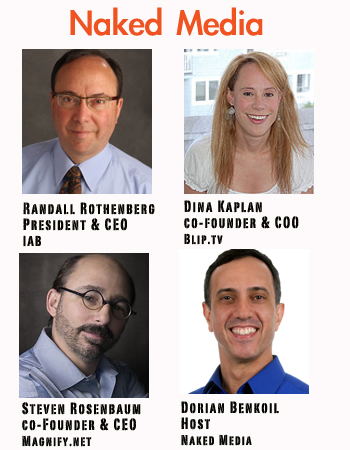
Live from the offices of the Interactive Advertising Bureau, the
trade association for interactive marketing in the United States, Dorian Benkoil of Teeming Media sits down for live video discussions with IAB president and CEO Randall Rothenberg, Magnify.net CEO Steve Rosenbaum and Blip.TV co-founder and COO Dina Kaplan.
Topic
We’re excited to do our first show from the IAB offices as part of our new partnership with the organization. We’ll first sit down with IAB president and CEO Randall Rothenberg to get his take on why “advertising is creepy,” as the IAB says in its new campaign to fend off privacy legislation, and talk about other industry trends and news. Then we’re joined by the founder and head of video platform Magnify.net, Steve Rosenbaum, and Dina Kaplan, co-founder of Blip.TV. We’ll talk about what is and isn’t working in video, about trends in curation and aggregation, details of sponsorship and revenue, and, of course your questions.
Plus, as always, Dorian’s “Shallow Thoughts” on the media, and recent coverage and interviews from industry trade shows.
And, of course: your questions. Send some now and sign in to get an email reminder before the show is live, December 9, 11:30 a.m. ET.
Register now to ask questions and get in on the discussion right away.
Bing and Google Go After Each Other With Ads
Trying to woo News Corp. isn't the only way Bing is taking it to Google. They're also placing ads on the Google site. Looking recently for a restaurant to have a business lunch at in New York, I noticed when I searched on Google Maps that Bing had placed an ad there.
And when I went to Bing, guess what? Google was doing the same.
(By the way, my search was a little too "natural language" for both sites. But that's a different story.)

CLICK THE IMAGE TO BLOW IT UP AND SEE MORE CLEARLY.
![Reblog this post [with Zemanta]](http://img.zemanta.com/reblog_e.png?x-id=c17d747b-4270-4fa8-96a8-aa4c38b4541b)
And when I went to Bing, guess what? Google was doing the same.
(By the way, my search was a little too "natural language" for both sites. But that's a different story.)

CLICK THE IMAGE TO BLOW IT UP AND SEE MORE CLEARLY.
Women and Social Marketing
"We're seeing a divide right now of where the women are leaping ahead of the brand and the brands are struggling to find how best to interact with them."
From Social Network Branding Fails to Sway Female Purchasing

From Social Network Branding Fails to Sway Female Purchasing
Subscribe to:
Posts (Atom)