Showing posts with label advertising. Show all posts

More Sophisticated Use of Google's Keywords and Adwords

To use Google Keywords tool, you should be logged in to get decent results, writes Malcolm Coles (@malcolmcoles) in his post Why you shouldn't use Google's keyword tool for SEO. He offers other tools he says are better.

Some people use Google's AdWords tool as a help as well, but there, too, you need to have some sophistication in understanding it. While the suggestion tool seems straightforward, offering terms that people search for and offering volumes and cost, it's useful to be a bit skeptical, and suspect that Google is offering you as many words as possible to try to get you to buy them. The more you bid on, the more they make, of course. I'm not saying they're dishonest, just that you have to apply some brain power. For example:
- Is past volume an indication of future volume, at least in your target audience for time period you want?
- How much competition is there for the word or phrase they're suggesting?
- Do you have content that will match the word or phrase well and give you a good score in Google Ad words, and therefore help keep your position high and cost low as people click through?

Coles, whom I was referred to by @PerfectMarket, writes that for SEO purposes "I tend to use a combination of Google Insights, Google Autocomplete for web searches and Google Autocomplete for News." He goes on his post, linked above, to describe issues and link to other tools.

Bing and Google Go After Each Other With Ads

Trying to woo News Corp. isn't the only way Bing is taking it to Google. They're also placing ads on the Google site. Looking recently for a restaurant to have a business lunch at in New York, I noticed when I searched on Google Maps that Bing had placed an ad there.

And when I went to Bing, guess what? Google was doing the same.

(By the way, my search was a little too "natural language" for both sites. But that's a different story.)


CLICK THE IMAGE TO BLOW IT UP AND SEE MORE CLEARLY.

Reblog this post [with Zemanta]

Ad Spend Down, IAB Says. Is it Right, Though?

Over at PaidContent, David Kaplan writes of the new IAB report saying ad spend is down more than 5 percent. Online.

But I ask (becuase PaidContent belched my comment): "Are other things that are now marketing but not ads in the traditional sense included in this?

"Virtual goods, Facebook fan pages, content widgets, dedicated blogs, YouTube videos, sms text messages, outdoor ads on digital signage, etc, etc.

Cuz if we count those, bet we'd see more money moving to digital than ever."

News and Advertising Converge

It's fascinating how the language of news and advertising are converging. Both sides now are talking of the need to "engage" their audiences, stop preaching from on high and include others in "the discussion" or "the conversation." Straddling the two worlds, as I do, I see them coming closing together than ever, rather than being diametrically opposed universes, as they used to be.

Meanwhile, Over at Internet Week

I'll be doing a lot of work on Internet Week in New York, this week, at the Pepsico sponsored site covering the events -- I'm editor in chief for the project.

Here's a post I wrote from the Conversational Marketing Summit hosted by Federated Media about how the wall's are coming down between advertising and editorial.

When News Follows Advertising

Tune in tomorrow for live video of the media summit, with live interviews from Naked Media.

= = = = =

It was striking at the Media Summit in New York today how definitive the people on the future of advertising panel seemed compared to the more unsettled tone of the one on the future of news. The news people, from Vanity Fair writer and Newser.com co-founder Michael Wolff (“We just don’t know how to fashion our product” for the new market of news consumers) to Michael Oreskes of AP and ex- of The New York Times (he said there’s a debate about whether there’s even such a thing as journalism) to Dick Meyer of NPR ex of CBS News (who quoted Clay Shirky’s recent essay on disruption of the newspaper business and said we "don’t have a clue" what’s next), were all candid about their grasp for a business model, let alone an editorial process and structure that works to produce news and satisfy an audience today. (Related thoughts on the disruption being much further than for news, here.)

Meanwhile, the advertising and marketing panelists sounded like they knew the solution -- engage consumers in a conversation, be part of a discussion, don’t just bombard them with ad messages -- and were convinced they simply have to lead others in the industry (product managers, marketers, media buyers) to think on their scale and not be locked into old methodologies. Bob Jeffrey of JWT said it doesn’t matter how much is spent on a campaign, what matters is how much it can engage an audience. Carl Fremont of Digitas called for more “active listening," then a “proactive, reactive strategy" of messaging back to consumers by joining in conversations they are having (presumably in places like social networks). He said old models of pushing ads at people weren’t going to work, and that there would be more development of social applications that provide real value and get consumers to opt in. The panelists all agreed on convergence, and also seemed to think TV would make a comeback as it became more addressable through digital technologies.

A later conversation I had with IBM researcher Bill Battino, who moderated the ad panel, said that the clients -- the companies buying the advertising -- were often leading the charge, had combined what were formally separate and segmented advertising and marketing budgets into a more unified whole from which they could then address the challenge of reaching audience through a holistic rather than silo’d media view (display ads, here, direct marketing over there...).

Whatever the state of play between clients and agencies, there was general agreement on the need for entering the “conversation” with consumers, rather than hitting them with messages, to get people to engage, to use technologies to know more about audiences, and to be genuine in messages, seemed to get general nods of agreement. One would think the same might hold for news ; after all, what better way to get at what a news consumers want than to ask them and have them contribute? I’m loathe, hesitant to say the advertising people are farther along in understanding the ways out of the current morass more than those producing news. But I can say I’ve seen it happen before, where the advertisers adapt and adopt a technology (behavioral targeting comes to mind) well before it’s talked about as a way of delivering content.

Does NY Mag Understand Newsweek's Business?

In New York Magazine's "numerical summary" of our economic times, they list the decline in the number of cars and light trucks sold, the proposed rise in the price of a transit farecard ... And the decline in guaranteed circulation for Newsweek magazine from 3.1 million in 2007 to a proposed 1.6 million in 2009.

But there's something the writers miss. Not only do they for some reason neglect 2008 (reported base of 2.6 million), but they also leave out a reasonable argument for the newsweekly to be cutting its circ: cutting costs, and the ability to raise ad rates for a more choice audience. As Ad Age reports:
Newsweek will likely take the opportunity to simultaneously steer toward a more a elite readership -- by eliminating the least-valuable, most-discounted subscriptions on its books.
Times are tough for print pubs, and magazines in recent months have started suffering some of the same steep declines newspapers have gotten used to. But it's also no secret that to get subscriptions, general interest weeklies and monthlies have practically given away the "book" for subscription prices that don't pay for the editions and thrown in premiums (such as umbrellas or tote bags) that can cost a good chunk of the subscription price.

So, while one could look at the move by Newsweek as an act of desperation brought on by declining economic times, we should also note that the company's rate base cut -- something Time did a couple years ago -- has been rumored since well before the current economic decline . It can get a smaller more valuable audience in print, leaving the less valuable but higher numerical audience, a lower-priced commodity for advertisers, to its digital side.

It's safe to say, too, that Newsweek isn't the only magazine thinking along these lines.

Naked Media: Be Less Social, Don't Measure

You should use digital media to find out what your consumers want and give it to them. Right? Maybe not. Every dollar spent on ads today should be measurable and trackable. True? Well, no.

Join us Wednesday at noon, ET, for our next episode of Naked Media when Brian Reich and Kendall Allen help host Dorian Benkoil shake up the conventional wisdom about the media.

Details here.

Social Networking, Data Mining, Media and Privacy

Had the pleasure Wednesday of seeing Michael Chin of Kickapps do a (kickass) presentation in my Digital Marketing class at Baruch's biz school. He demonstrated not only how social media centered around a brand or organization can cultivate enthusiasm (and generally give an indicator of sentiment), but also how much mineable data there is about each participant in the network. That data goes beyond the typical demographic info -- zip code, age, gender and so on -- into deeper direct or inferential matter about everything from the person’s preferences, lifestyle,“friends,” and even to clues about what enthuses, delights and annoys them. One avid basketball fan Chin showed, for example, had put a wealth of info about herself in reams of discussion posts, videos, comments, still photos on a team’s fan site. That’s a gold mine for that team if it chooses to access it.

Chin, at the Social Times conference  (which my company helped produce the media for) a few weeks earlier had told me that CRM (Customer Relationship Management) can become a lot more than the grid-driven database systems we have today. True, powerful tools like SalesForce.com allow collaborative workers to share information and better serve (and sell and upsell) clients and potential customers. Just call a rep at your cellphone provider to see, in action, how a good customer database system can tell the person on the other end of the line all kinds of things about you that might get you to either stay happy with them or pay for more service.

But those systems pale in comparison to the kinds of data we’re giving about ourselves on personalized media like social networks and Twitter. Imagine if through some sort of Semantic Web application a company could glean information not only on what info you offered, and tags you’d left, but also the things you were passionate about, what you’d been writing and saying, asking for and complaining about. Imagine if the company could handle the complaint or fuel the delight of that passionate, highly involved (ok, “engaged”) fan -- how much might she crow about you, then, an not only increase her loyalty but also help spur others into the fold?

True, it’s a lot of work. And some of the work is subtle and requires a very human touch. We don’t today have an algorithm that can mine such soft and random data in this way (though a recent Open Calais demonstration did wow me to the possibilities), and it takes a human touch to understand the not-so-fine line between delighting someone and making them feel you’ve gone over the creepy edge into invading their privacy. 

And what about the cost? Chin half-jokingly bristled when I asked if he could map social media back to a return on the investment. It would take a lot of data and crunching to even try to get at whether the dollars spent mining the social info is more cost-effective than the more blunt-force forms of marketing and communication more prevalent today. Certainly, none of it lives in a vacuum, and it goes along with other messaging, so it's next to impossible to separate out the effect. And there is, of course, more than a hint of self-serving in Chin’s remarks (use social media, and delight your customers!). But that doesn't make his point invalid.

We can assume, be nearly sure, that the data mining, perhaps driven by Semantic Web-type applications (even a quick run through “Wordle.com” can show you the terms someone is using most, let alone the Calais system of auto-sifting) will improve and that the point at which the parsing needs to get handed over to a human will be pushed further down the line, weighted more to technology and less to the humans. It makes sense for the people at media companies -- who can help mine and sell their data -- social networks and marketers to think along these lines.

Broadcast TV Down: Is That Bad News?

One way to make money from TV other than ads in the program.

Today’s Wall St. Journal story on the decline in TV ratings snapped me back to an alternate universe, a week after listening to ABC’s digital programming EVP Albert Cheng talk about revenue “per episode" at the Streaming Media West show. If broadcast TV executives are counting their pennies the way the “blast-from-the-past” story described it, they are in trouble:

Many viewers haven't rushed back to their television sets to watch this year's highly promoted season premieres, preferring to catch the shows on digital video recording devices and online -- or not catch them at all.

An average of 9 million people tuned in to prime-time programs on the top five English-language broadcast networks the night they aired last week, a 4.3% decline from the first week of the 2007 TV season, according to Nielsen Media Research.


OK, the “not catch them at all” part would be distressing. But why would watching in some fashion other than linear broadcast be considered a negative? Advertisers and Nielsen are already allowing for the “+3” formulation that accounts for viewers who watch a show up to three days after initial airing. TiVO has good measures of how many ads are viewed in a DVR’d program, making the case that even when forwarded through, some ads stick. Ads that are actually watched on a DVR are probably more impactful than on broadcast. And, what about the bathroom or snack or pick-up-a-coffee-table-magazine breaks during commercials?

Perhaps NBC’s Jeff Zucker was right when he said that NBC now has to manage not for ratings, but rather for profitability. What’s a show worth if you add up the revenues not just from broadcast TV ads (and reruns and overseas...) but also DVD and iTunes sales, and Web and mobile and anything else from which you can make a penny? Perhaps broadcast’s worth can even be counted as a marketing opportunity for sales in the other platforms.

It’s not like any TV executive should, at this point, be surprised by any of this, except perhaps the pace, accelerated by the apparent lasting effect of the writer’s strike. It’s not like DVRs or the Web are a surprise at this point. Sure, the days when a TV ad sales exec could just wait for the phone to ring and take the order are long gone. A show that’s a hit has so much more than broadcast TV to rely on. That people are watching in other ways than over the air should be seen as a triumph of the programming, not a downside. Even for ads, there are innovative ways to go about it. There's no reason, for example, that commercials have to be exactly 30 seconds and fit neatly into a format that's decades old (and easy to skip and avoid). Now, it’s the executives’ jobs to turn that popularity into money. That takes work, sure. But that’s all it is.

Reblog this post [with Zemanta]

Naked Media Goes Mobile

In a wide-ranging yet very specific discussion with Jerry Rocha of Nielsen and Bob Walczak of mobile ad company RingLeader Digital we explored everything from the fate of mobile advertising (there may be one), to how minorities are using mobile devices in the U.S. more than the mainstream, to ways in which the iPhone (gasp!) doesn't quite work.

See Episode 5 on the Naked Media site. And check out the blog for some "man on the street" interviews where we show that all the whizbang we discuss in the studio (and at trade shows, industry magazines and the like) is far ahead of the crowd.

Reblog this post [with Zemanta]

'Please Leave Your Ad Blocking Software On'


A frame grab from Hulu.com.

Albert Cheng: Closed is Open, but Money Matters

Summarizing two posts I wrote on CNET's Webware and the Naked Media blog, from Disney-ABC EVP for digital media Albert Cheng:

1. ABC, though requiring people to watch Web video in the ABC player is open because it's working so hard to give people video when, where and how they want -- everywhere from the ABC site to Facebook, AOL and Veoh.
2. You have to think of the digital media business not purely in terms of revenue per viewer or per ad, but rather *per episode,* where, he said, ABC's digital properties were not that far off TV, sort of like the comparison of a teenager to an adult, not pennies to the dollar.

User-Generated Outlandishness

From the IBM report "The end of advertising as we know it," discussing why advertising agencies and marketers in general will have to get more used to the idea of users creating advertising.

If the rise of user-generated advertising seems "outlandish," consider how far-fetched the idea of a consumer generated encyclopedia was only a few years ago.


As always, it behooves content creators (journalists, others) to look at what the agencies are doing, or being told to do, what the trends are. Use of technologies to create and engage.

Jarvis Likes His Bottoms on Top

I wrote teasingly about a year ago about an ad for clean bottoms on Buzzmachine. Now, author Jeff Jarvis says he likes the current underwear ad on his site that a few have called him to task for. Nothing heavy here, just jawboning on a Friday

Naked Media, Episode 3, Part II


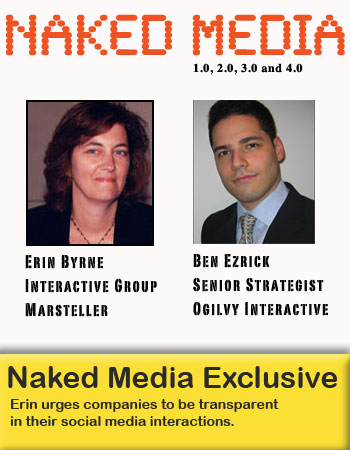
In which Erin Byrne talks about how being open has gotten her in trouble, and we ask a lot of user questions.

We've also created a little confusion about what Naked Media is. The answer: a show about media we're producing in partnership with Scribe Media.

The New Ambiguity: You Can't Have it Both Ways

In spite of all the new ability to measure. digital media also present new challenges in figuring out what works. This thought gelled for me during the Naked Media discussion with Erin Byrne and Ben Ezrick, both leading digital strategists, he for Ogilvy, she for Burson-Marsteller. We watched the Bronze Lion-winning but fake JC Penney ad that has finally been removed from YouTube after getting hundreds of thousands of views. The commercial was since withdrawn from the awards, apparently.

The video shows two teenagers "Speed Dressing," timing themselves as they put on their clothes after undressing to "get away with it" in the girl's basement -- a message a Penney marketing manager has said the company would never condone. But the company has also gotten a lot of notice for the ad, which, as The Wall Street Journal points out , may curry favor with more urban teens, especially on the coasts. So, for a mass brand like Penney, they condemn the ad. But they, perhaps, reap the benefits of the branding in a measurable way -- hundreds of thousand saw the video before it was pulled, and it's now available on other sites. Ezrick, in the Naked Media segment, points out that neither Penney nor its ad agency, Saatchi and Saatchi, have yet completely explained how the ad got to be entered in the Cannes awards contest, nor exactly how people affiliated with them were involved in producing the video.

Both Ezrick and Byrne point out that Penney can't have it both ways: If they genuinely don't condone the video, they need to investigate and reveal how it came to be to the best of their knowledge. If they had something to do with it, they must say so, and, if need be, apologize honestly for any discomfort or harm they may have caused. But what they can't do is reap the benefits of the video going viral and also be upset while they gain brand awareness. You also can't, in a digital age, segment audiences as you could in a previous era, showing one ad to the coasts, say, and another to "Middle America." Perhaps digital media means everything is outed, eventually. And that means we have to be more honest, or at least more consistent.

Naked Media, Episode 3: What's an Ad?


In which digital strategists Erin Byrne and Ben Ezrick from Marsteller and Ogilvy, respectively, talk about what's an ad, and I talk about teeny-tiny information technology.

Ask Two Digital Strategists


Next guests on Naked Media: Chief Digital Strategist for Marsteller, Erin Byrne, and Ogilvy digital strategist Ben Ezrick. We'll ask 'em about viral video, crisis management, and just what a digital strategist is, anyway.

UPDATE: Great, fun show. Watch TeemingMedia.com to catch it on demand.

Upcoming Media-Tech Plays

Jordan Rohan, of Clearmeadow Partners, on what he "likes" as upcoming media/tech plays, after saying the companies that are going to change the landscape in next 5-10 years don't exist today. At the Digital Publishing and Advertising Conference in NY.

Likes:

* Widget-ized contextual content and advertising ("two-in-a-box"). “Advertising and content need to go hand in hand.” Not syndicate content into somone else’s page. Don’t have to people bring back to your homepage to serve them content or sell an ad. Eliminates the problem some of the portals are going through now. “If NYT could figure out a way to sell ads against [their widget] they’ve got me looking at their ads for ever and ever.” (Later, NYT product manager Mike Foley directly contradicts this, saying "we’re in distributingg content in any way possible and GETTING THEM BACK TO THE SITE and getting them engaged.")

* Super local lead-generation platforms.

* Innovative iPhone apps. The $200 iPhone “will be selling on eBay for $300.” iPhone at $199 is “going to change everything.” The graduation gift of ’09, or Xmas gift of ’08.

* High-margin e-commerce companies with buying power. Company sells $6M of hammocks, with 50% margins. .. have buying power, because aggregate so much demand. ...

* Successful resellers of carbon emission credits for consumers.

* Commercial applications for Twitter: I am a business looking for something. ... it’s going to change some sector of the economy... some company is going to figure it out.