Just posted on Bob Garfield's TheChaosScenario.net:
By Dorian Benkoil
It’s odd that Hulu doesn’t let Boxee easily put up its material. Boxee, if you’re not one of the swelling ranks of digerati, is a venture capital-backed open-source software project formed by an Israeli former military computer coder and his friends to let folks listen to, watch and tell each other online about all the videos, music, and photos they’re consuming. Boxee, which is in its early “alpha” testing stage and already claims 500,000 members, wants to create a “lean-back” experience for those who want to use a remote to easily click on whatever they want -- Netflix on Demand, iTunes music, YouTube, family photos from the laptop -- in a seamless interface that looks nice and avoids tons of mouse clicks and typing. And to do it on a TV, if they want, by hooking up the computer to the TV. Boxee, which by Fall plans to emerge in “Beta”, has been working on deals with various TV-connected device makers (like Roku and AppleTV) to bring their software to even more of the masses.
Hulu, of course, is the joint venture of three major TV networks to put their programming online, and, in the process, serve lots of high-priced ads in a format that can’t be skipped or TiVO’d or otherwise avoided. (Word is, that at least some Hulu ads, on a per-viewer basis, as of last month started costing more than similar ones on TV.) But for some reason, Hulu doesn’t want Boxee to make Hulu programming (everything from movies to popular shows like The Simpsons, Desperate Housewives and The Daily Show) available on Boxee. Apparently, the masters of Hulu don’t want to make the site readily available on Boxee because not only do they lose some control, but also because people might then be more inclined to watch TV programming via Hulu rather than over their cable, on-air or satellite boxes, for which the TV network folks spend tons of time and money negotiating rights, deals and so on. Boxee does have a workaround -- you can put Hulu’s RSS feed in your Boxee profile and get at least some of the programs that way. It’s more cumbersome than the Boxee grid that shows little expandable squares amalgamated on a screen.
But there’s another really easy way to watch Hulu on your TV: plug the laptop into your TV without worrying about Boxee. I bought a $24 connector (Boxee CEO Avner Ronen quipped that I’d “overpaid”), and my children and I have watched tons of programs through the computer on our large-screen TV over our wireless home Internet network. I set up a mouse and speakers and everything, and many’s the time my children lie on the couch watching their favorite shows without going through our digital cable box. It took me a little time to rig up, but it was worth it to give them the access they wanted (which, by the way, is often commercial-free), whether over Hulu, Netflix-on-Demand, YouTube or whatever.
So, while I do understand the possible business rationales for Hulu telling Boxee to not put them in their easy-to-use grid -- they want to control the user interface, they want to be compensated, they don’t want cable TV providers like Time Warner and Comcast to think of them as facilitating an “end-run” -- it’s a short-term protective game for which there’s an easy workaround. It’s more a blocking maneuver to preserve an existing model than a real, long-term strategy that could succeed over time to get loyal Hulu viewers.
Ronen, who’s very plain spoken and always willing to say things that will cause heartburn to traditional media execs, talked about some of this on my show Naked Media last week, appearing with former HuffingtonPost CEO Betsy Morgan. He said he’s talking to everyone he can at whatever network but gets tied up in a lot of wrangles over rights and such. His ultimate goal, he said, is to be the software that drives any and all connected video devices, whether the Roku box or a set-top cable box. And, he says, Hulu should be glad to be in the Boxee system, because his users will send them more traffic, and get more viewers for their programming and ads. He’s agnostic as to the model of the provider -- if someone can only access programming via subscription, he’s happy to provide it that way. He says that by early next year Boxee hopes to even have a payment system in place. The episode of Naked Media will be available on demand soon, and in iTunes.
Showing posts with label Naked Media. Show all posts
Showing posts with label Naked Media. Show all posts


Next Naked Media: Betsy Morgan, Boxee CEO Avner Ronen
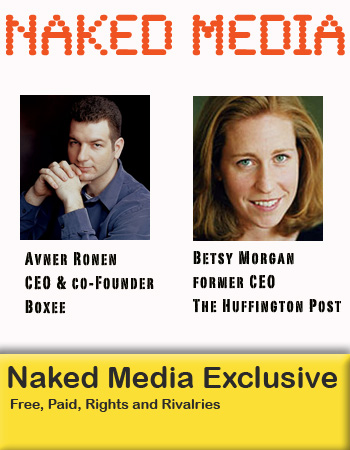
Avner Ronen, CEO of fast-growing media aggregation and social networking startup Boxee, doesn’t shy from speaking his mind — even when it gets him in trouble with major TV networks. Betsy Morgan knows TV networks from the inside — she led CBS News digital — and how to bring a startup to the next level, as the CEO of Huffington Post.
We’ll ask Avner and Betsy your questions as well as things on our minds, such as: Can Boxee negotiate the TV network demands and ongoing disputes with Hulu? What’s up with their recently-announced redesign and new features? Can Comcast’s attempts to challenge Hulu possibly succeed? Why did Betsy leave (was she really booted?) the HuffPost and what’s next for her? Whither HuffPost now that a venture capital executive is in charge? And money money money: who’s making it, how to make it, and much much more.
Plus as, always, the innovative ideas and “aha” moments you can use, fun with Dorian’s “Shallow Thoughts,” and other recent coverage.
Register now to ask questions and get in on the discussion right away. You will also receive a reminder email to tune in for the live show the day before.
The Media Consumer's Bill of Rights
I told my guests today on Naked Media, designer Roger Black and Complex Media CEO Rich Antoniello, that I had started to draft a (half-joking) “media consumer’s bill of rights.” They asked me to share it with them. I have. And here I’m sharing it with you:
THE MEDIA CONSUMER'S BILL OF RIGHTS
AS A MEDIA CONSUMER, I DESERVE:
But I’d love to hear yours.
REALLY
PS The media professional's bill of rights, I guess, would be the right to break any and all of the above any time the professional can find a business model to justify it; alienated consumers notwithstanding.
THE MEDIA CONSUMER'S BILL OF RIGHTS
AS A MEDIA CONSUMER, I DESERVE:
- TO BE ABLE TO RECORD SOMETHING -- ANYTHING -- IN ONE ROOM AND CONSUME IT IN ANOTHER ROOM, WITHOUT HAVING TO PAY EXTRA
- TO READ ANYTHING I'M READING ON WHATEVER I CHOOSE TO READ IT ON -- WITHOUT HAVING TO PAY OVER AND OVER AND OVER. KINDLE, E-BOOK, PRINT, BLACKBERRY, WHATEVER! LET ME SWITCH AROUND!
- TO CHOOSE WHETHER TO WATCH ADS AND GET SOMETHING FOR FREE, OR PAY TO GET IT WITHOUT THE ADS
- TO HAVE THE ADS SHOW FOR LESS TIME THAN THE PROGRAMMING (OR AT LEAST FOR IT TO FEEL THAT WAY)
- TO NEVER FEEL GOUGED FOR THE MEDIA I PAY FOR ($20 for a CD? $50 for a DVD? When you’ve already made a big profit and it costs you maybe a couple bucks to manufacture, distribute and promote? C'mon.)
- TO (OH, HORROR!) BE ABLE TO SAMPLE IT ALL AT THE LIBRARY.
- AND , FINALLY, TO BE ABLE TO CONNECT ALL MY MEDIA DEVICES AND MOVE PROGRAMMING AROUND ON THEM -- AS EASILY AS I CAN NOW DRAG AND DROP TEXT FILES.
But I’d love to hear yours.
REALLY
PS The media professional's bill of rights, I guess, would be the right to break any and all of the above any time the professional can find a business model to justify it; alienated consumers notwithstanding.
Naked Media Measurement Jingle (and Show)
And the show, with Jon Gibs of Nielsen, and Todd Juenger of TiVo, talking about the ins and outs of media measurement.
Larry Kramer: Another Financial News Venture
Larry Kramer, who founded Marketwatch and sold it to Dow Jones for $500 million, hints that he'll be getting back into the news business, maybe even financial and business news, in this segment of Naked Media.
Crovitz, Brill in New Pay Journalism Project
Steve Outing today pointed me to Journalism Online, a new attempt to charge for journalistic content. The press release makes it seem they’ll be offering readers a way to pay one price and pick from among paid content they want, and publishers a chance to make their efforts available at a price point they choose. Users will be able to pick stories a la carte, or via subscription. The release frequently mentions newspapers, but also says there are talks with magazines.
The release says ads, alone, can’t and never have paid for quality journalism. Maybe not. And we’ll find out if J.O. is right that Americans will pay for journalism because they understand it needs to be supported. I’m not so sure. They will pay for convenience, ease of use, utility and access they wouldn’t otherwise have.
What will make this work, I think, is from the reader side:
... and for publishers:
I can imagine some arduous negotiations with publishers, many of whom will take the position that their content is invaluable, deserves a higher percentage, and so on. J.O. will have to hold the line and figure out incentives, as well as, perhaps, cut some special deals for must-have publications. I also can’t help but wonder what scale Journalism Online needs to break even. It would seem to be a perfect model from their standpoint -- they are a platform, with relatively low cost, paying nothing to create content, and can scale at little incremental cost. If the application they provide goes on the publisher site, even easier for J.O. The only stipulation for publishers is that they charge for at least some of their content, meaning they can still make much of it free, and, presumably, get the benefits of linking, SEO and the like.
It will be a delicate and difficult balance among all the participants, and finding terms they all can live with. There will have to be adjustments over time. Other experiments along these lines -- including Congoo, in which I was a minor participant -- have not been overwhelming successes. Still, with Gordon Crovitz participating, it could work. He’s the former Wall Street Journal publisher who’s been lionized for helping build the WSJ.com brand to, maybe $100 million per year in subscriptions, a figure Larry Kramer mentioned on Naked Media yesterday (we’re promised the on demand version will be ready this week; check NakedMedia.org).
What media consumer isn’t enticed by the idea of paying one reasonable price and then getting whatever you want from, say, a swathe of subscription newspapers and magazines? This was an attraction of AOL in earlier days (they offered Time Inc. magazines through the service), and got them some added subscriptions. What if we could also add publications from Conde Nast, Meredith, Hearst and others? What if it were also the Financial Times and Wall Street Journal? (But can J.O. really herd all these cats together?) J.O. will have to be significantly less expensive than existing aggregators like Factiva, as well. And, Crovitz had the WSJ to work with -- that’s was a preeminent must-have brand for a well-heeled, info-hungry mobile audience.
The other founders are Court TV and American Lawyer founder Stephen Brill, and former cable exec Leo Hindery.
The release says ads, alone, can’t and never have paid for quality journalism. Maybe not. And we’ll find out if J.O. is right that Americans will pay for journalism because they understand it needs to be supported. I’m not so sure. They will pay for convenience, ease of use, utility and access they wouldn’t otherwise have.
What will make this work, I think, is from the reader side:
- if they can get what they want with ease
- if the price point is low enough that convenience outweighs the desire to go hunting for the info elsewhere (think iTunes)
- If there are enough publications available
- if the content is not commoditized or the kinds of stuff available so many other places that it’s easy to find. (I doubt breaking news or big stories available all over the place will make much money.)
... and for publishers:
- the ability to make additional incremental revenue from content they couldn’t get on their own.
- strong Incentives to cooperate in the project rather than go it alone, as they’re so used to doing
ease of installation and use - flexible pricing -- Journalism Online is promising to let publishers charge their own prices and adjust them.
- data, which J.O. is also promising, to allow quick changes in pricing, story mix, etc. (“Journalism Online will provide reports to member publishers on which strategies and tactics are achieving the best results in building circulation revenue while maintaining the traffic necessary to support advertising revenue.”)
- assurance their content won’t be pilfered, will be in an environment they can trust in every sense
- enough revenue and revenue share that they’ll feel it’s a fair shake, that J.O. isn’t taking too much of a cut.
I can imagine some arduous negotiations with publishers, many of whom will take the position that their content is invaluable, deserves a higher percentage, and so on. J.O. will have to hold the line and figure out incentives, as well as, perhaps, cut some special deals for must-have publications. I also can’t help but wonder what scale Journalism Online needs to break even. It would seem to be a perfect model from their standpoint -- they are a platform, with relatively low cost, paying nothing to create content, and can scale at little incremental cost. If the application they provide goes on the publisher site, even easier for J.O. The only stipulation for publishers is that they charge for at least some of their content, meaning they can still make much of it free, and, presumably, get the benefits of linking, SEO and the like.
It will be a delicate and difficult balance among all the participants, and finding terms they all can live with. There will have to be adjustments over time. Other experiments along these lines -- including Congoo, in which I was a minor participant -- have not been overwhelming successes. Still, with Gordon Crovitz participating, it could work. He’s the former Wall Street Journal publisher who’s been lionized for helping build the WSJ.com brand to, maybe $100 million per year in subscriptions, a figure Larry Kramer mentioned on Naked Media yesterday (we’re promised the on demand version will be ready this week; check NakedMedia.org).
What media consumer isn’t enticed by the idea of paying one reasonable price and then getting whatever you want from, say, a swathe of subscription newspapers and magazines? This was an attraction of AOL in earlier days (they offered Time Inc. magazines through the service), and got them some added subscriptions. What if we could also add publications from Conde Nast, Meredith, Hearst and others? What if it were also the Financial Times and Wall Street Journal? (But can J.O. really herd all these cats together?) J.O. will have to be significantly less expensive than existing aggregators like Factiva, as well. And, Crovitz had the WSJ to work with -- that’s was a preeminent must-have brand for a well-heeled, info-hungry mobile audience.
The other founders are Court TV and American Lawyer founder Stephen Brill, and former cable exec Leo Hindery.
Ask Larry Kramer - April 14 on Naked Media
I'll be hosting Larry Kramer, founder of Marketwatch, of CBS' digital media division and really smart media and money guy on the next Naked Media, Tuesday, April 14, from 12:00 - 1:00pm EST.
I'm really excited to have him as a guest. Got a question for him? Send it along in the comments, or email, Tweet, Link In, or mentally beam me through my dental filings with what you'd like to ask. And please watch. You can logon here, now for a reminder and to ask questions or chart directly on the Naked Media show.
It should be a great show. Larry's not only really smart, is not afraid to speak his mind.
I'm really excited to have him as a guest. Got a question for him? Send it along in the comments, or email, Tweet, Link In, or mentally beam me through my dental filings with what you'd like to ask. And please watch. You can logon here, now for a reminder and to ask questions or chart directly on the Naked Media show.
It should be a great show. Larry's not only really smart, is not afraid to speak his mind.
Media Summit, New York
Check out the live stream of Digital Hollywood's Media Summit from McGraw Hill building in NY. We will be grabbing on-camera interviews as can, as well, for Naked Media, most with host Dorian Benkoil.
Check out stream and catch the interviews, here.
Check out stream and catch the interviews, here.
Where Does For-Profit End and Social Good Begin?
Michael Cervieri at Scribe, whom I work closely with on Naked Media and other projects, writes about a complaint against the Boston Globe website, which has used material under a Creative Commons license, but may be violating its terms because it's for-profit. Here's my take, left on their site as a comment:
The discussion of commercial vs. non-commercial is becoming ever more difficult. Innocentive -- a Game Changer award-winner from our Naked Media media partners "We Media" is venture funded and helps companies get crowd-sourced solutions to their scientifically oriented challenges (injecting flouride into toohpaste, finding a new chemical compound, etc.) but is also helping find cures to AIDS and ALS for charitable foundations.
SocialVibe, another award-winner that's also venture-funded and for-profit, helps users place ads on social networks like Facebook, and elect a charity to which the ad money goes.
We could be cut and dry: is the entity created and incorporated, is its legal tax status "not-for-profit." In that case, both the above companies fail the sniff test Michael alludes to. But, isn't that, then, shooting some not-for-profits in the foot, if we force the narrow interpretation on them?
I have been personally working with We Media, and will be going to the conference in Miami next week. Having interviewed all the award-winners, I came across this new trend of holding both capitalistic and social ideas in one's head at the same time. I don't think one has to say it's one or the other.
The discussion of commercial vs. non-commercial is becoming ever more difficult. Innocentive -- a Game Changer award-winner from our Naked Media media partners "We Media" is venture funded and helps companies get crowd-sourced solutions to their scientifically oriented challenges (injecting flouride into toohpaste, finding a new chemical compound, etc.) but is also helping find cures to AIDS and ALS for charitable foundations.
SocialVibe, another award-winner that's also venture-funded and for-profit, helps users place ads on social networks like Facebook, and elect a charity to which the ad money goes.
We could be cut and dry: is the entity created and incorporated, is its legal tax status "not-for-profit." In that case, both the above companies fail the sniff test Michael alludes to. But, isn't that, then, shooting some not-for-profits in the foot, if we force the narrow interpretation on them?
I have been personally working with We Media, and will be going to the conference in Miami next week. Having interviewed all the award-winners, I came across this new trend of holding both capitalistic and social ideas in one's head at the same time. I don't think one has to say it's one or the other.
Kindle 2: More Open?
Finished the Amazon Kindle 2 e-reader news conference this morning, and you can read all about it all over the place, including my twitter feed, with hashtag #kindle.
I've asked for a review copy and will let you know (at Naked Media) what I think of it. From appearance, it's a next generation of the device: thinner, a tad lighter, easier to navigate with a new 5-way button, better resolution with its e-ink, and importantly, charging via a USB and a strong text-to-speech reader.
But what strikes me is something Amazon isn't revealing details about, but which has been rumored and CEO Jeff Bezos confirmed: Users will be able to read Kindle purchases on the Kindle 1, the Kindle 2 and unspecified other devices, apparently smartphones. A Kindle exec I asked wouldn't say which ones, or what the pricing or terms would be, but the aim he said is to have multiple devices. Bezos said reading something on one device, then moving over to another you'd be able to pick up where you left off. That's a tiny hint of the kind of openness Kindle will need, I think, to survive long-term. As I've written before, I tried to love my Kindle, but couldn't get into it because though it is an electronic device it is a closed system that doesn't allow me to grab pieces, move the pieces around, access them from anywhere and so on.
One other thing I noticed: the test customers on a video Amazon showed, maybe 8-10 of them, all appeared to be 40 or older, or youngest in their thirties.
I've asked for a review copy and will let you know (at Naked Media) what I think of it. From appearance, it's a next generation of the device: thinner, a tad lighter, easier to navigate with a new 5-way button, better resolution with its e-ink, and importantly, charging via a USB and a strong text-to-speech reader.
But what strikes me is something Amazon isn't revealing details about, but which has been rumored and CEO Jeff Bezos confirmed: Users will be able to read Kindle purchases on the Kindle 1, the Kindle 2 and unspecified other devices, apparently smartphones. A Kindle exec I asked wouldn't say which ones, or what the pricing or terms would be, but the aim he said is to have multiple devices. Bezos said reading something on one device, then moving over to another you'd be able to pick up where you left off. That's a tiny hint of the kind of openness Kindle will need, I think, to survive long-term. As I've written before, I tried to love my Kindle, but couldn't get into it because though it is an electronic device it is a closed system that doesn't allow me to grab pieces, move the pieces around, access them from anywhere and so on.
One other thing I noticed: the test customers on a video Amazon showed, maybe 8-10 of them, all appeared to be 40 or older, or youngest in their thirties.
Fundamental, Not Cyclical - Media Becoming a Different Beast
While the current economic crisis is unveiling a wealth of troubles for many businesses and industries, it’s also masking some fundamental issues. Advertisers, publishers and media companies will presume that, once the economy picks up again, and marketers assign larger budgets, that they, ad-supported media, will come roaring back with the economy.
But even Disney CEO Bob Iger acknowledges that changes in consumer behavior are due to more than the economy. Craig Moffett, an industry analyst at Sanford C. Bernstein & Company, told The New York Times that it's not correct to call the slowdown in cellphone sales "a cyclical problem."
Companies that seize market share and are able to do well over the next six months or year may, indeed, shoot out of the gates toward the end of ’09, or beginning of ’10 (advertising tends to be a trailing economic indicator, unlike the stock market, which leads). Traditional media that hasn’t done a good enough job of addressing the market shifts may do better then, but over time will be in jeopardy -- a possibility picked up noted by NY Convergence (which I've helped build as a consultant), contrasting the forward-looking mood at the AlwaysOn On Media conference with the somber orientation of media execs at the Crain conference across town in New York.
At the On Media conference you could almost feel a shift in the air. Everyone was questioning everything: What valuations are, whether the venture capital model really works, whether VCs ask too much for their money, whether ad targeting and re-targeting will fall prey to privacy concerns; even the demise of ad networks that bought lots of inventory who are now sunk by using arbitraging schemes of buying ad space in bulk from the likes of Yahoo, and are now unable to sell it at a profit. At the same time, a bunch of widget-makers like RockYou and Meebo, and ad networks, and early stage investors talked about great growth and huge opportunities. There’s some real disruption here, and it’s fundamental. Social media expert Larry Weber likened big media's practices of demanding control to mafiosi, and hinted that unpaid media would bust the system apart.
The shifts, I'd say, are more fundamental, even than the old saw about horse and buggy or train companies not understanding they were in the transportation industry. The new media industry may not be like the old media industry. Sure there is still advertising and aggregating audiences. Great stuff -- content, we now say -- gets watched and read and listened to. You can talk about audiences, and demographics, and screens and technologies. Fred Seibert, ex of MTV and other traditional media, now of Next New Networks, kept driving the point home in the most recent episode of Naked Media (soon to be live at NakedMedia.org) how much he could draw on lessons of the past to inform his practices today. Yes, but. And it’s a big but, because today’s media require not only a different set of technical skills, but also a different mindset, one where literally everyone with any networked device has the tools to do something they can call media. A world where media consumers want to talk back not by yelling at the TV or writing a Letter an Editor may not publish, but by getting a response from the media creators and purveyors. Where fans will take and make something their own, and a media company can be created from a search algorithm.
The mindset and skills of today require a type of openness to innovation and audience participation (and I even recoil a bit at that phrase, because it’s almost as if there is no longer an audience that’s separate from the producers) that’s quite alien to many folks who’ve made media for decades. When the economy gets better, that will help us see how fundamental the shift has been.
But even Disney CEO Bob Iger acknowledges that changes in consumer behavior are due to more than the economy. Craig Moffett, an industry analyst at Sanford C. Bernstein & Company, told The New York Times that it's not correct to call the slowdown in cellphone sales "a cyclical problem."
Companies that seize market share and are able to do well over the next six months or year may, indeed, shoot out of the gates toward the end of ’09, or beginning of ’10 (advertising tends to be a trailing economic indicator, unlike the stock market, which leads). Traditional media that hasn’t done a good enough job of addressing the market shifts may do better then, but over time will be in jeopardy -- a possibility picked up noted by NY Convergence (which I've helped build as a consultant), contrasting the forward-looking mood at the AlwaysOn On Media conference with the somber orientation of media execs at the Crain conference across town in New York.
At the On Media conference you could almost feel a shift in the air. Everyone was questioning everything: What valuations are, whether the venture capital model really works, whether VCs ask too much for their money, whether ad targeting and re-targeting will fall prey to privacy concerns; even the demise of ad networks that bought lots of inventory who are now sunk by using arbitraging schemes of buying ad space in bulk from the likes of Yahoo, and are now unable to sell it at a profit. At the same time, a bunch of widget-makers like RockYou and Meebo, and ad networks, and early stage investors talked about great growth and huge opportunities. There’s some real disruption here, and it’s fundamental. Social media expert Larry Weber likened big media's practices of demanding control to mafiosi, and hinted that unpaid media would bust the system apart.
The shifts, I'd say, are more fundamental, even than the old saw about horse and buggy or train companies not understanding they were in the transportation industry. The new media industry may not be like the old media industry. Sure there is still advertising and aggregating audiences. Great stuff -- content, we now say -- gets watched and read and listened to. You can talk about audiences, and demographics, and screens and technologies. Fred Seibert, ex of MTV and other traditional media, now of Next New Networks, kept driving the point home in the most recent episode of Naked Media (soon to be live at NakedMedia.org) how much he could draw on lessons of the past to inform his practices today. Yes, but. And it’s a big but, because today’s media require not only a different set of technical skills, but also a different mindset, one where literally everyone with any networked device has the tools to do something they can call media. A world where media consumers want to talk back not by yelling at the TV or writing a Letter an Editor may not publish, but by getting a response from the media creators and purveyors. Where fans will take and make something their own, and a media company can be created from a search algorithm.
The mindset and skills of today require a type of openness to innovation and audience participation (and I even recoil a bit at that phrase, because it’s almost as if there is no longer an audience that’s separate from the producers) that’s quite alien to many folks who’ve made media for decades. When the economy gets better, that will help us see how fundamental the shift has been.
The Future (and Threat To) TV, and TiVO
On Wednesday’s “Naked Media” live show (soon to be available on demand at NakedMedia.org), Web TV entrepreneur (and long-time TV animation executive) Fred Seibert talked about how TiVo brought a lot of viewers to the programs on his Next New Networks, home of everything from car enthusiast shows to Obama Girl on “Barely Political” to shows for people crazy for comic books. He said that TiVo, hungry for content to distribute to TiVo subscribers, had struck deals with Web content providers like his company. Fred gets distribution to a new audience (and more views for ads). TiVo gets more content to subscribers paying their monthly fees.
TiVo, thus, becomes a box that not only allows time-shifting of traditional TV and ad-skipping, but also viewing of quality Web content on the TV as well. That’s something a lot of consumers don’t realize.
Later, at the Future of TV conference in midtown Manhattan, TiVO’s VP and GM, Audience Research and Measurement Todd Juenger said he didn’t like the traditional ways of classifying audience for advertising measurement purposes, that demographic groupings, such as women ages 18-49, were a far-from-perfect proxy for what advertisers really want. Procter & Gamble, where he once worked, is interested in women who want to use a particular product in a particular way: women interested buying a detergent with a particular smell, for example. That’s much more important than their age or any other group measurement. Beer companies would love to know if a household tends to buy Budweiser or Miller -- something, Juenger said, TiVo can tell when it maps the household to data from a grocery story shopping card such as that provided by the company Experion.
TiVo, thus becomes not just a measurement box, but the means by which an advertiser can serve ads more perfectly targeted to a household.
But TiVo, while a triple threat, also faces a threat. I asked Juenger whether the Internet was threatening his company just as his company threatens ad revenues for broadcast and cable TV. He said he felt there was room for it all, that TV screens are the better experience and that TiVo was bringing programming to people over those screens.
Well, yes. But. What about the increasing improvement in screens of all types, the desire for people to watch what they want wherever, however? Later at the conference, both a Fox executive and ABC's Rick Mandler pointed out that while the audience was still miniscule, the viewership of their programs on computer screens was growing (and they could build players for computers that didn't allow ad skipping). Seibert said he would provide his programming on any screen where people were demanding it. There’s not yet enough viewership on mobile screens like iPhones, he said, but as soon as there is, he’ll be signing distribution deals. And, when there is, where will TiVo be? If TiVo’s main value proposition is showing stuff on a TV hooked up to its machine, and that becomes irrelevant because Hulu or ABC.com or the Roku box hooked up to Netflix, or Apple TV provides the programming on-demand -- what would that do to TiVo’s business?
TiVo, thus, becomes a box that not only allows time-shifting of traditional TV and ad-skipping, but also viewing of quality Web content on the TV as well. That’s something a lot of consumers don’t realize.
Later, at the Future of TV conference in midtown Manhattan, TiVO’s VP and GM, Audience Research and Measurement Todd Juenger said he didn’t like the traditional ways of classifying audience for advertising measurement purposes, that demographic groupings, such as women ages 18-49, were a far-from-perfect proxy for what advertisers really want. Procter & Gamble, where he once worked, is interested in women who want to use a particular product in a particular way: women interested buying a detergent with a particular smell, for example. That’s much more important than their age or any other group measurement. Beer companies would love to know if a household tends to buy Budweiser or Miller -- something, Juenger said, TiVo can tell when it maps the household to data from a grocery story shopping card such as that provided by the company Experion.
TiVo, thus becomes not just a measurement box, but the means by which an advertiser can serve ads more perfectly targeted to a household.
But TiVo, while a triple threat, also faces a threat. I asked Juenger whether the Internet was threatening his company just as his company threatens ad revenues for broadcast and cable TV. He said he felt there was room for it all, that TV screens are the better experience and that TiVo was bringing programming to people over those screens.
Well, yes. But. What about the increasing improvement in screens of all types, the desire for people to watch what they want wherever, however? Later at the conference, both a Fox executive and ABC's Rick Mandler pointed out that while the audience was still miniscule, the viewership of their programs on computer screens was growing (and they could build players for computers that didn't allow ad skipping). Seibert said he would provide his programming on any screen where people were demanding it. There’s not yet enough viewership on mobile screens like iPhones, he said, but as soon as there is, he’ll be signing distribution deals. And, when there is, where will TiVo be? If TiVo’s main value proposition is showing stuff on a TV hooked up to its machine, and that becomes irrelevant because Hulu or ABC.com or the Roku box hooked up to Netflix, or Apple TV provides the programming on-demand -- what would that do to TiVo’s business?
Watch Fred Seibert on Naked Media, Noon ET!
Can Anyone Make it as a (Web Video) Entrepreneur?
Fred Siebert, founder of Next New Networks, will stop by the Scribe Studio on January 21 to talk about making the transition from network television heavy-weight to scrappy new media entrepreneur.
Join us for this live video webcast.
Fred Seibert is not only an award-winning cartoon producer who lead the remake of Nickelodeon into a leading cable network and was the original creative director for MTV. He also is the co-founder of Next New Networks, the Web-based home of Barely Political (hosted by Obama Girl) and ultra-niche networks for auto racing fanatics, comic-book enthusiasts. NNN has raised more than $23 million in funding from high profile venture firms like Spark Capital and Goldman Sachs, and recently brought on former MTV and Nickelodeon exec Lance Podell as CEO.
Seibert is plain-spoken and refreshingly candid about everything from how he’s raised money, to whether Web-based video like his can turn a profit, how he goes about finding talented people and turning their ideas into a businesses like the new blogging tool Tumblr and more — all while admitting huge failures, including one just a decade ago that cost him nearly every dollar he had.
Naked Media host (and MediaFlect author) Dorian Benkoil and Seibert will talk about the plans for Next New Networks, being an entrepreneur, and what anyone can learn from his triumphs and mistakes. Expect a wide-ranging, fun and frank discussion instructive for anyone in the media business today.
Fred Siebert, founder of Next New Networks, will stop by the Scribe Studio on January 21 to talk about making the transition from network television heavy-weight to scrappy new media entrepreneur.
Join us for this live video webcast.
Fred Seibert is not only an award-winning cartoon producer who lead the remake of Nickelodeon into a leading cable network and was the original creative director for MTV. He also is the co-founder of Next New Networks, the Web-based home of Barely Political (hosted by Obama Girl) and ultra-niche networks for auto racing fanatics, comic-book enthusiasts. NNN has raised more than $23 million in funding from high profile venture firms like Spark Capital and Goldman Sachs, and recently brought on former MTV and Nickelodeon exec Lance Podell as CEO.
Seibert is plain-spoken and refreshingly candid about everything from how he’s raised money, to whether Web-based video like his can turn a profit, how he goes about finding talented people and turning their ideas into a businesses like the new blogging tool Tumblr and more — all while admitting huge failures, including one just a decade ago that cost him nearly every dollar he had.
Naked Media host (and MediaFlect author) Dorian Benkoil and Seibert will talk about the plans for Next New Networks, being an entrepreneur, and what anyone can learn from his triumphs and mistakes. Expect a wide-ranging, fun and frank discussion instructive for anyone in the media business today.
"Shallow Thoughts:" We Need Biochip Implants
This one's about how we all need biochip implants so we can consume media as quickly as we download it.
Part of the "Naked Media" show. Most recent episode: Five Things to Change Your (Digital) Life, with Amy Webb of Webb Media Group.
Five Things to Change Your (Digital) Life
Today (Tuesday). Noon, ET. Ask questions about Geospatial Webb, Visual Search, Semantic Web and more.
Guest: Amy Webb.
Naked Media: Be Less Social, Don't Measure
You should use digital media to find out what your consumers want and give it to them. Right? Maybe not. Every dollar spent on ads today should be measurable and trackable. True? Well, no.
Join us Wednesday at noon, ET, for our next episode of Naked Media when Brian Reich and Kendall Allen help host Dorian Benkoil shake up the conventional wisdom about the media.
Details here.
Join us Wednesday at noon, ET, for our next episode of Naked Media when Brian Reich and Kendall Allen help host Dorian Benkoil shake up the conventional wisdom about the media.
Details here.
Ways Around Text Messaging Fees
A significant portion of the recent Naked Media show was on fees for mobile (cellphone) use, and how people are going directly to the Web to get video and other material rather than subscribing and paying a new fee for a subscription, on top of their data plans.
Occurred to me today that the mobile Twitter app (interestingly, link is a Blogspot blog) is a way to avoid text messaging fees. You can post to the mobile Twitter site, and hit people directly (if they follow you), and also blast the wider group. Less of a sure thing than text messages -- which you can be pretty sure are consumed by those you're sending to -- but it's a way for people to go "off-deck" for text messages, too, from their handhelds, and end-run another money maker for mobile carriers.
Naked Media: All Mobile
Next Naked Media: All About Mobile. Noon ET, Thursday, Send questions, in comments.
The Week: Aggregator or Analyzer?
The Week’s Steven Kotok today spent a lot of time on Naked Media insisting that the magazine is not just an aggregator but is really about opinion and intelligence. That they’re more pickers and choosers than smart analyzers is a common perception. From today’s WSJ:
Fellow show guest and media critic Michael Wolff also called the publication a “picker” of content -- in a similar way to his own Newser.com Other Wolff revelations: Newser.com plans absolutely no original content, ever. It will be profitable next year, if all goes as now. They’ll pass 1 million monthly uniques soon.
I pressed a lot on whether something like Newser can really get traction and hold on. Wolff insists there’s a great mass of people who will always be there, and want a branded news site that puts together a wide swathe of news. I lean more towards the belief that fragmentation is leading to niches of “vertical” coverage, and that those who want news of various types or on various subjects will assemble their own aggregations in a feed reader or similar. They can then look at their favorite sports, local news, international news, and so on.
The episode of Naked Media will be available on demand soon.
The Week condenses commentary on the world's news into small, easily digestible bites.
Fellow show guest and media critic Michael Wolff also called the publication a “picker” of content -- in a similar way to his own Newser.com Other Wolff revelations: Newser.com plans absolutely no original content, ever. It will be profitable next year, if all goes as now. They’ll pass 1 million monthly uniques soon.
I pressed a lot on whether something like Newser can really get traction and hold on. Wolff insists there’s a great mass of people who will always be there, and want a branded news site that puts together a wide swathe of news. I lean more towards the belief that fragmentation is leading to niches of “vertical” coverage, and that those who want news of various types or on various subjects will assemble their own aggregations in a feed reader or similar. They can then look at their favorite sports, local news, international news, and so on.
The episode of Naked Media will be available on demand soon.
Subscribe to:
Posts (Atom)