Investors here at the AlwaysOn media conference have been confirming in private discussions and on stage what angel investor David Rose said recently: that their money is having to stretch farther, that others are reluctant to come into the rounds as early.
One venture capital investor also told me he’s seeing “A Series pricing” for B and C rounds, meaning that people investing even later in a company’s life cycle are able to, for their money, get a larger share of the equity. For example, instead of getting 15 percent of the company, they’re able to get a fifth of it, he said.
But in a sign of optimism, another, based in Silicon Valley, said that funds of money that were raised 1-2 years ago are still uninvested, so they will need soon to find something to invest in in the next few months.
Later, on a panel about later-stage venture capital investment, Alan Spoon, Managing General Partner of Polaris Venture Partners, said he was seeing more funds looking to others for liquidity, trying to shore up balance sheets and less interested in such calculations as ROI (return on investment -- which in the financial world is a more specific ratio than often gets thrown around in advertising) and IRR, another ratio that figures out the internal rate of return -- how much a company is supposed to be able to earn from the money it has.
The pressures on the markets are making hedge funds and mutual funds get out of the venture game, the panelists also said, and money is being lent and companies being valued at much lower valuations than before the bust.
Showing posts with label Investing. Show all posts
Showing posts with label Investing. Show all posts


Spend Less, Gain Market Share
"When you’re comparing yourself to companies that are spending ‘like drunks,’ you should take comfort, because market share will come to you merely by outlasting them."-- Richard de Silva, General Partner, Highland Capital Partners, at the AlwaysOn OnMedia conference in New York
David Rose: Investments Need To Generate Cash
David Rose, NY Angels founder and head of investment incubator RoseTech Ventures, says his potential portfolio companies today must make money in a way they didn’t have to a year ago.
In early 2008, Rose would help start a business presuming venture capitalists and others would soon come kick in more. Today, “we can’t assume there will be anyone after us with a follow-on round,” he said at a NY:MIEG breakfast event at the Samsung Experience in the Time Warner Center at Columbus Circle. “We are really only looking at businesses that can get to profitability” on their own, and show growth, then, perhaps, get more investment in 2-3 years. The panel, titled, “The Economic Downturn’s Impact on Media & Entertainment,” explored how business has changed for media and technology businesses in recent months, and what prospects may be.
Rose was on the panel with Andrew Cleland, Executive Director of Alliances and Technology Strategy of Time Warner, and Robert Rechti, who is a senior VP and Industry Advisor for GE Commercial Finance’s Media, Communications and Entertainment business. Dale Peskin, co-founder of iFOCOS, host of February’s We Media conference in Miami, moderated. Cleland and Rechti both said they hold to the same principles as before the economy tanked, doing due diligence, though they may now look for more cash flow and flexible business plans, and be more selective in their deals.
(Note: My company, Teeming Media, has done business with both NY:MIEG and We Media.)
In early 2008, Rose would help start a business presuming venture capitalists and others would soon come kick in more. Today, “we can’t assume there will be anyone after us with a follow-on round,” he said at a NY:MIEG breakfast event at the Samsung Experience in the Time Warner Center at Columbus Circle. “We are really only looking at businesses that can get to profitability” on their own, and show growth, then, perhaps, get more investment in 2-3 years. The panel, titled, “The Economic Downturn’s Impact on Media & Entertainment,” explored how business has changed for media and technology businesses in recent months, and what prospects may be.
Rose was on the panel with Andrew Cleland, Executive Director of Alliances and Technology Strategy of Time Warner, and Robert Rechti, who is a senior VP and Industry Advisor for GE Commercial Finance’s Media, Communications and Entertainment business. Dale Peskin, co-founder of iFOCOS, host of February’s We Media conference in Miami, moderated. Cleland and Rechti both said they hold to the same principles as before the economy tanked, doing due diligence, though they may now look for more cash flow and flexible business plans, and be more selective in their deals.
(Note: My company, Teeming Media, has done business with both NY:MIEG and We Media.)
David Rose Tells me What He Taught Me
David left the below in the comments, but I'm bringing it out front, because it's a great clarification and enhancement to what I had written:
1) The Most Important Person on the Startup Team
In a blog post that I wrote on the subject after it came up in a conversation on the nextNY mailing list, I posit that it's not "the techie", nor "the UI person" nor even "the biz guy"...but rather The Entrepreneur... someone with a special set of skils and characteristics that may—or may not—be co-resident with the other functional skills mentioned above.
2) The Ten Crucial Attributes of an Entrepreneur
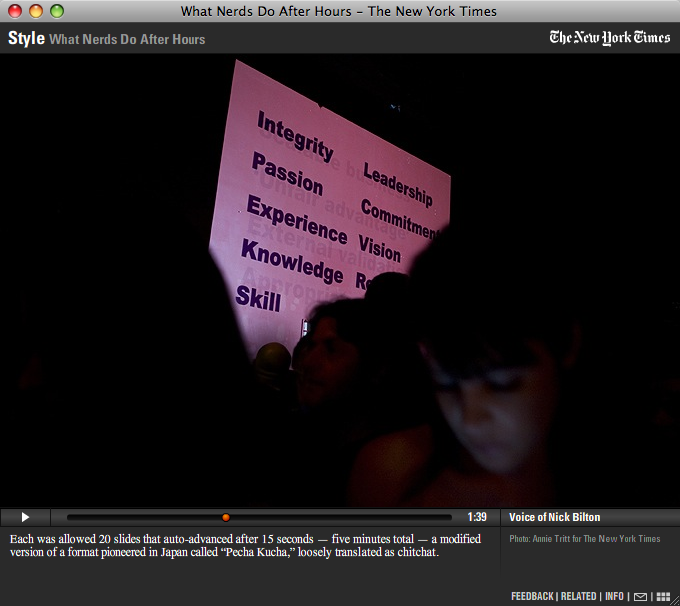
Although I haven't yet taken the time to blog about this one yet, it has been a staple of my business school lectures (and was captured by the New York Times during my Ignite presentation last month). In a nutshell, I have found that most investors look for the following ten 'must-haves' (pretty much in this order) in their search for the Perfect Entrepreneur: Integrity, Passion, Startup Experience, Domain Expertise, Functional Skills, Leadership, Commitment, Vision, Realism and 'Coachability'.
3) The Entrepreneur/Investor Disconnect on Returns
My point here was that even if you could get a typical entrepreneur and a typical investor to agree on the same target investment return for the investor (say, 25% IRR, as a reasonably high return for investing in a really risky startup), there is a gaping chasm between the two, because the entrepreneur looks at the question in light of his or her own venture, whereas the investor looks at it in light of his or her entire portfolio. The result is that the entrepreneur has heart attack when, having come to such an agreement, the investor says, "great, now that, of course, means that I need to get thirty times my money back from YOUR company! I've gone through the math in detail on my blog, but a crib note version is available over on Center Networks from a presentation I gave last Spring.
1) The Most Important Person on the Startup Team
In a blog post that I wrote on the subject after it came up in a conversation on the nextNY mailing list, I posit that it's not "the techie", nor "the UI person" nor even "the biz guy"...but rather The Entrepreneur... someone with a special set of skils and characteristics that may—or may not—be co-resident with the other functional skills mentioned above.
2) The Ten Crucial Attributes of an Entrepreneur
Although I haven't yet taken the time to blog about this one yet, it has been a staple of my business school lectures (and was captured by the New York Times during my Ignite presentation last month). In a nutshell, I have found that most investors look for the following ten 'must-haves' (pretty much in this order) in their search for the Perfect Entrepreneur: Integrity, Passion, Startup Experience, Domain Expertise, Functional Skills, Leadership, Commitment, Vision, Realism and 'Coachability'.
3) The Entrepreneur/Investor Disconnect on Returns
My point here was that even if you could get a typical entrepreneur and a typical investor to agree on the same target investment return for the investor (say, 25% IRR, as a reasonably high return for investing in a really risky startup), there is a gaping chasm between the two, because the entrepreneur looks at the question in light of his or her own venture, whereas the investor looks at it in light of his or her entire portfolio. The result is that the entrepreneur has heart attack when, having come to such an agreement, the investor says, "great, now that, of course, means that I need to get thirty times my money back from YOUR company! I've gone through the math in detail on my blog, but a crib note version is available over on Center Networks from a presentation I gave last Spring.
Things I Learned from David Rose
Angel investor and pitch expert David Rose was in fine form at the Shake Shack gathering this evening, holding court and telling us the key traits he tells his biz school students make an entrepreneur. They are, as I remember:
You also need a team: sales, tech, BizDev, ... and an entrepreneur, who can be one of the folks doing other function(s) on the team, someone to marshall the others -- a team can’t really be bought, Rose says, and who lives, eats and breathes the stuff. Someone who is by nature that person, an entrepreneur. Someone who, if this one fails, is going to make it on the next one, or the next, or one of the ones after that and so is worth the investment because s/he’ll eventually pay off. You need 30X potential return, because only 1 of ten ventures will make it, and it has to pay for all the rest, at a rate that’s better than if you, say, put your $$ in a hedge fund.
- Integrity. The most important trait. Rose won’t give money to you if a whiff of dishonesty crosses his sensors. He’s giving you his money for your idea, and he wants to make sure it’s in the right place.
- Passion
- Great idea
- Domain experience (helps if someone’s done something related before, and, perhaps, had successful business)
- Leadership
You also need a team: sales, tech, BizDev, ... and an entrepreneur, who can be one of the folks doing other function(s) on the team, someone to marshall the others -- a team can’t really be bought, Rose says, and who lives, eats and breathes the stuff. Someone who is by nature that person, an entrepreneur. Someone who, if this one fails, is going to make it on the next one, or the next, or one of the ones after that and so is worth the investment because s/he’ll eventually pay off. You need 30X potential return, because only 1 of ten ventures will make it, and it has to pay for all the rest, at a rate that’s better than if you, say, put your $$ in a hedge fund.
Subscribe to:
Posts (Atom)